Window: Charge
[Created: 04/12/1999 - Updated: 02/01/2000 ]
Description: Maintain Charges
Help: The Charges Window defines the different charges that may be incurred. These can include Bank Charges, Vendor Charges and Handling Charges.
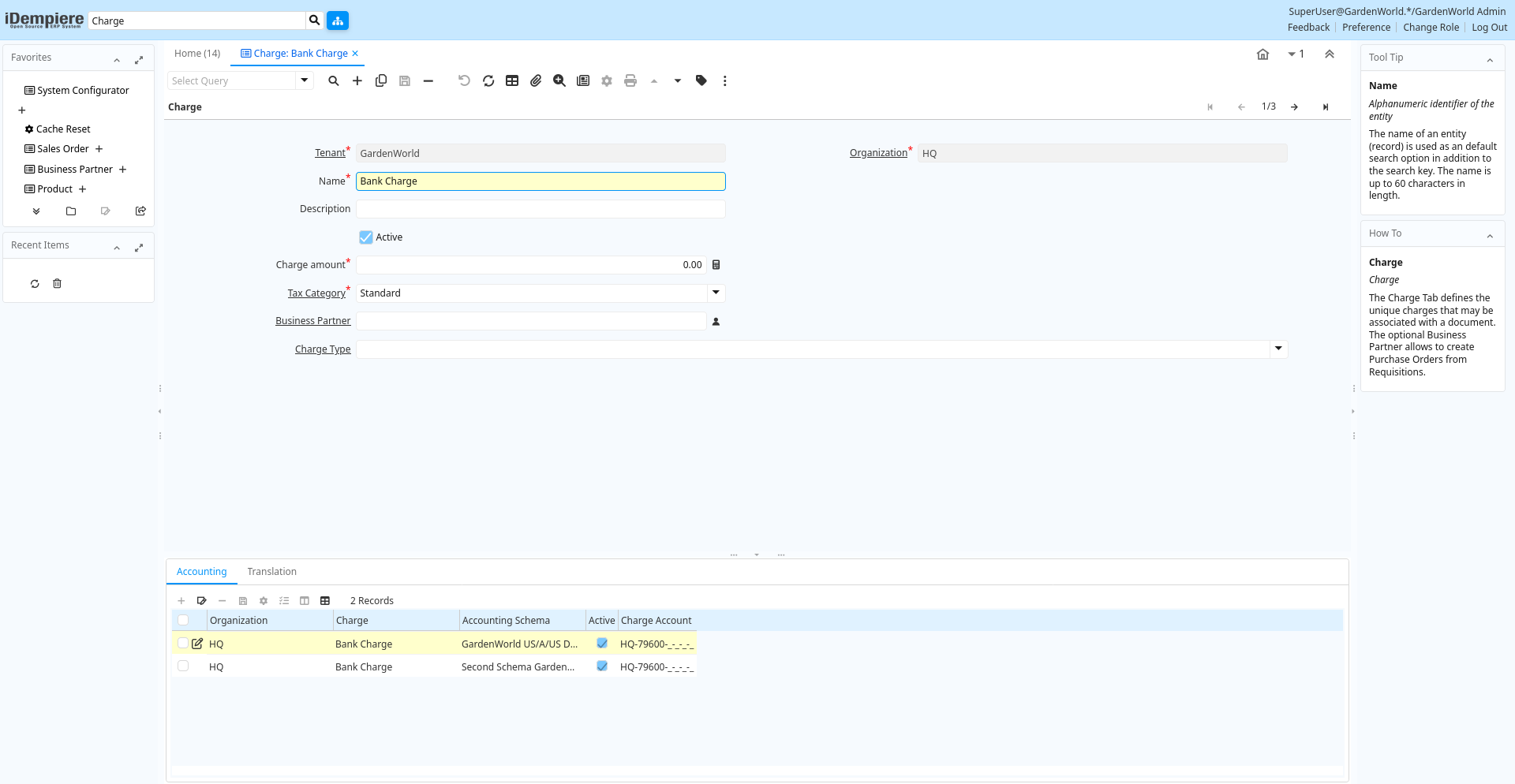
Tab: Charge
[Created: 04/12/1999 - Updated: 19/01/2006 ]
Description: Charge
Help: The Charge Tab defines the unique charges that may be associated with a document.The optional Business Partner allows to create Purchase Orders from Requisitions.
Tab Level: 0
Table 10: Charge - Fields
Table: Report Parameters
| Name | Description | Help | Technical Info |
|---|---|---|---|
| Tenant | Tenant for this installation. | A Tenant is a company or a legal entity. You cannot share data between Tenants. | c_charge.AD_Client_ID numeric(10) Table Direct |
| Organization | Organizational entity within tenant | An organization is a unit of your tenant or legal entity - examples are store, department. You can share data between organizations. | c_charge.AD_Org_ID numeric(10) Table Direct |
| Name | Alphanumeric identifier of the entity | The name of an entity (record) is used as an default search option in addition to the search key. The name is up to 60 characters in length. | c_charge.Name character varying(60) String |
| Description | Optional short description of the record | A description is limited to 255 characters. | c_charge.Description character varying(255) String |
| Active | The record is active in the system | There are two methods of making records unavailable in the system: One is to delete the record, the other is to de-activate the record. A de-activated record is not available for selection, but available for reports.There are two reasons for de-activating and not deleting records:(1) The system requires the record for audit purposes.(2) The record is referenced by other records. E.g., you cannot delete a Business Partner, if there are invoices for this partner record existing. You de-activate the Business Partner and prevent that this record is used for future entries. | c_charge.IsActive character(1) Yes-No |
| Charge amount | Charge Amount | The Charge Amount indicates the amount for an additional charge. | c_charge.ChargeAmt numeric Amount |
| Tax Category | Tax Category | The Tax Category provides a method of grouping similar taxes. For example, Sales Tax or Value Added Tax. | c_charge.C_TaxCategory_ID numeric(10) Table Direct |
| Business Partner | Identifies a Business Partner | A Business Partner is anyone with whom you transact. This can include Vendor, Customer, Employee or Salesperson | c_charge.C_BPartner_ID numeric(10) Search |
| Charge Type | c_charge.C_ChargeType_ID numeric(10) Table Direct |
Tab: Accounting
[Created: 19/12/2000 - Updated: 05/03/2013 ]
Description: Charge Accounting
Help: The Accounting Tab defines the accounting parameters used for transactions including a charge or charges.
Tab Level: 1
Table 20: Accounting - Fields
Table: Report Parameters
| Name | Description | Help | Technical Info |
|---|---|---|---|
| Tenant | Tenant for this installation. | A Tenant is a company or a legal entity. You cannot share data between Tenants. | c_charge_acct.AD_Client_ID numeric(10) Table Direct |
| Organization | Organizational entity within tenant | An organization is a unit of your tenant or legal entity - examples are store, department. You can share data between organizations. | c_charge_acct.AD_Org_ID numeric(10) Table Direct |
| Charge | Additional document charges | The Charge indicates a type of Charge (Handling, Shipping, Restocking) | c_charge_acct.C_Charge_ID numeric(10) Table Direct |
| Accounting Schema | Rules for accounting | An Accounting Schema defines the rules used in accounting such as costing method, currency and calendar | c_charge_acct.C_AcctSchema_ID numeric(10) Table Direct |
| Active | The record is active in the system | There are two methods of making records unavailable in the system: One is to delete the record, the other is to de-activate the record. A de-activated record is not available for selection, but available for reports.There are two reasons for de-activating and not deleting records:(1) The system requires the record for audit purposes.(2) The record is referenced by other records. E.g., you cannot delete a Business Partner, if there are invoices for this partner record existing. You de-activate the Business Partner and prevent that this record is used for future entries. | c_charge_acct.IsActive character(1) Yes-No |
| Charge Account | Charge Account | The Charge Account identifies the account to use when recording charges | c_charge_acct.Ch_Expense_Acct numeric(10) Account |
Tab: Translation
[Created: 17/04/2009 - Updated: 27/10/2024 ]
Description: Translation
Help: The Translation Tab defines a Document Type in an alternate language.
Tab Level: 1
Table 30: Translation - Fields
Table: Report Parameters
| Name | Description | Help | Technical Info |
|---|---|---|---|
| Tenant | Tenant for this installation. | A Tenant is a company or a legal entity. You cannot share data between Tenants. | c_charge_trl.AD_Client_ID numeric(10) Table Direct |
| Organization | Organizational entity within tenant | An organization is a unit of your tenant or legal entity - examples are store, department. You can share data between organizations. | c_charge_trl.AD_Org_ID numeric(10) Table Direct |
| Charge | Additional document charges | The Charge indicates a type of Charge (Handling, Shipping, Restocking) | c_charge_trl.C_Charge_ID numeric(10) Table Direct |
| Language | Language for this entity | The Language identifies the language to use for display and formatting | c_charge_trl.AD_Language character varying(6) Table |
| Active | The record is active in the system | There are two methods of making records unavailable in the system: One is to delete the record, the other is to de-activate the record. A de-activated record is not available for selection, but available for reports.There are two reasons for de-activating and not deleting records:(1) The system requires the record for audit purposes.(2) The record is referenced by other records. E.g., you cannot delete a Business Partner, if there are invoices for this partner record existing. You de-activate the Business Partner and prevent that this record is used for future entries. | c_charge_trl.IsActive character(1) Yes-No |
| Description | Optional short description of the record | A description is limited to 255 characters. | c_charge_trl.Description character varying(255) String |
| Name | Alphanumeric identifier of the entity | The name of an entity (record) is used as an default search option in addition to the search key. The name is up to 60 characters in length. | c_charge_trl.Name character varying(60) String |
| Translated | This column is translated | The Translated checkbox indicates if this column is translated. | c_charge_trl.IsTranslated character(1) Yes-No |