Window: Process Customization
[Created: 24/11/2017 - Updated: 20/09/2023 ]
Description: Define Process Customization for Role/User
Help: The customization values defined here overwrite/replace the default system definition if defined.
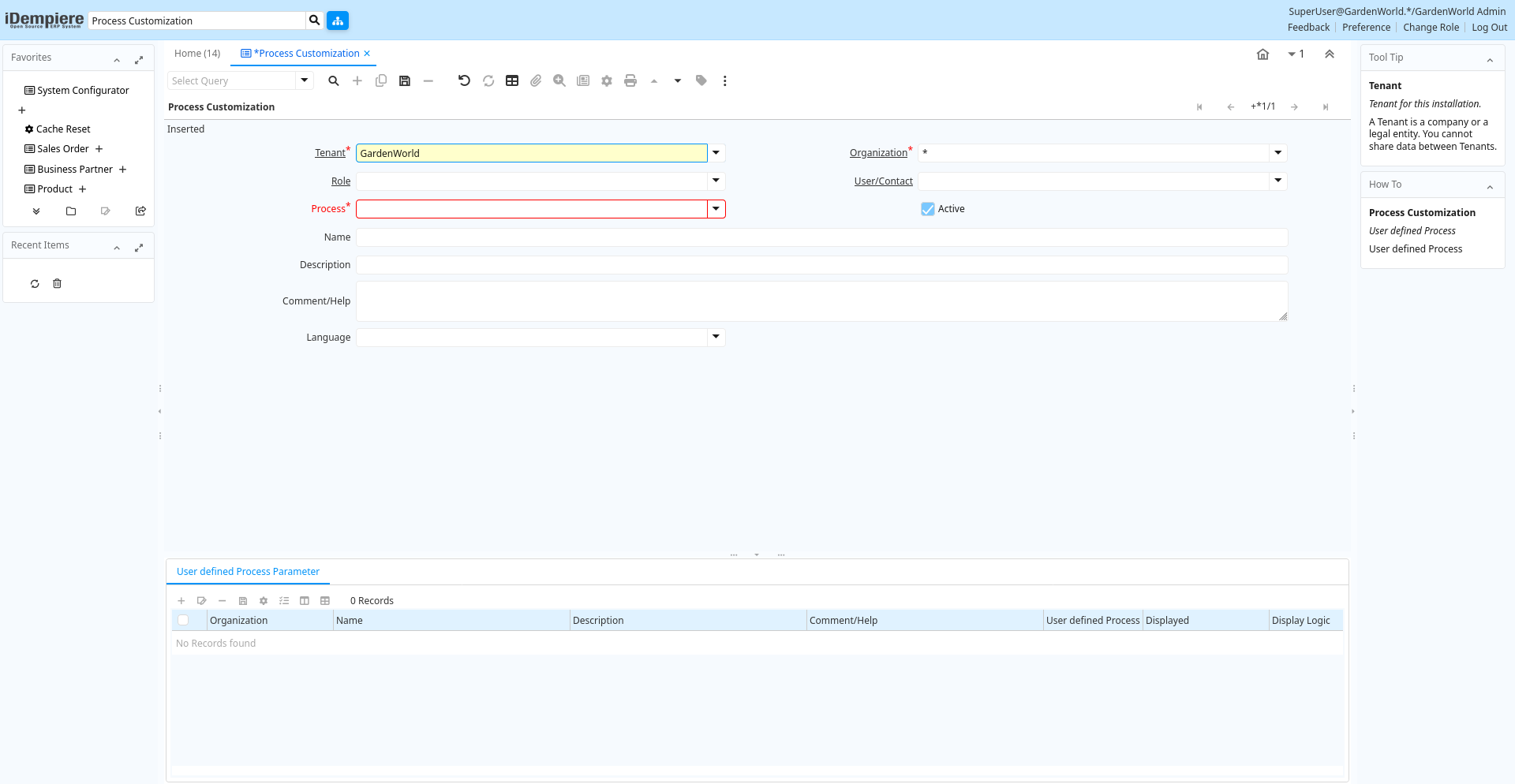
Tab: Process Customization
[Created: 24/11/2017 - Updated: 27/10/2024 ]
Description: User defined Process
Help: User defined Process
Tab Level: 0
Table 10: Process Customization - Fields
Table: Report Parameters
| Name | Description | Help | Technical Info |
|---|---|---|---|
| Tenant | Tenant for this installation. | A Tenant is a company or a legal entity. You cannot share data between Tenants. | ad_userdef_proc.AD_Client_ID numeric(10) Table Direct |
| Organization | Organizational entity within tenant | An organization is a unit of your tenant or legal entity - examples are store, department. You can share data between organizations. | ad_userdef_proc.AD_Org_ID numeric(10) Table Direct |
| Role | Responsibility Role | The Role determines security and access a user who has this Role will have in the System. | ad_userdef_proc.AD_Role_ID numeric(10) Table Direct |
| User/Contact | User within the system - Internal or Business Partner Contact | The User identifies a unique user in the system. This could be an internal user or a business partner contact | ad_userdef_proc.AD_User_ID numeric(10) Table Direct |
| Process | Process or Report | The Process field identifies a unique Process or Report in the system. | ad_userdef_proc.AD_Process_ID numeric(10) Table Direct |
| Active | The record is active in the system | There are two methods of making records unavailable in the system: One is to delete the record, the other is to de-activate the record. A de-activated record is not available for selection, but available for reports.There are two reasons for de-activating and not deleting records:(1) The system requires the record for audit purposes.(2) The record is referenced by other records. E.g., you cannot delete a Business Partner, if there are invoices for this partner record existing. You de-activate the Business Partner and prevent that this record is used for future entries. | ad_userdef_proc.IsActive character(1) Yes-No |
| Name | Alphanumeric identifier of the entity | The name of an entity (record) is used as an default search option in addition to the search key. The name is up to 60 characters in length. | ad_userdef_proc.Name character varying(60) String |
| Description | Optional short description of the record | A description is limited to 255 characters. | ad_userdef_proc.Description character varying(255) String |
| Comment/Help | Comment or Hint | The Help field contains a hint, comment or help about the use of this item. | ad_userdef_proc.Help character varying(2000) Text |
| Language | Language for this entity | The Language identifies the language to use for display and formatting | ad_userdef_proc.AD_Language character varying(6) Table |
Tab: User defined Process Parameter
[Created: 24/11/2017 - Updated: 27/10/2024 ]
Description: User defined Process Parameter
Help: User defined Process Parameter
Tab Level: 1
Table 20: User defined Process Parameter - Fields
Table: Report Parameters
| Name | Description | Help | Technical Info |
|---|---|---|---|
| Tenant | Tenant for this installation. | A Tenant is a company or a legal entity. You cannot share data between Tenants. | ad_userdef_proc_parameter.AD_Client_ID numeric(10) Table Direct |
| Organization | Organizational entity within tenant | An organization is a unit of your tenant or legal entity - examples are store, department. You can share data between organizations. | ad_userdef_proc_parameter.AD_Org_ID numeric(10) Table Direct |
| User defined Process | Primary Key : User defined Process | Primary Key : User defined Process | ad_userdef_proc_parameter.AD_UserDef_Proc_ID numeric(10) Table Direct |
| Active | The record is active in the system | There are two methods of making records unavailable in the system: One is to delete the record, the other is to de-activate the record. A de-activated record is not available for selection, but available for reports.There are two reasons for de-activating and not deleting records:(1) The system requires the record for audit purposes.(2) The record is referenced by other records. E.g., you cannot delete a Business Partner, if there are invoices for this partner record existing. You de-activate the Business Partner and prevent that this record is used for future entries. | ad_userdef_proc_parameter.IsActive character(1) Yes-No |
| Process Parameter | ad_userdef_proc_parameter.AD_Process_Para_ID numeric(10) Table Direct | ||
| Range | The parameter is a range of values | The Range checkbox indicates that this parameter is a range of values. | ad_userdef_proc_parameter.IsRange character(1) Yes-No |
| Name | Alphanumeric identifier of the entity | The name of an entity (record) is used as an default search option in addition to the search key. The name is up to 60 characters in length. | ad_userdef_proc_parameter.Name character varying(60) String |
| Description | Optional short description of the record | A description is limited to 255 characters. | ad_userdef_proc_parameter.Description character varying(255) String |
| Comment/Help | Comment or Hint | The Help field contains a hint, comment or help about the use of this item. | ad_userdef_proc_parameter.Help character varying(2000) Text |
| Placeholder | ad_userdef_proc_parameter.Placeholder character varying(255) String | ||
| Placeholder2 | ad_userdef_proc_parameter.Placeholder2 character varying(255) String | ||
| Sequence | Method of ordering records; lowest number comes first | The Sequence indicates the order of records | ad_userdef_proc_parameter.SeqNo numeric(10) Integer |
| Reference | System Reference and Validation | The Reference could be a display type, list or table validation. | ad_userdef_proc_parameter.AD_Reference_ID numeric(10) Table |
| Reference Key | Required to specify, if data type is Table or List | The Reference Value indicates where the reference values are stored. It must be specified if the data type is Table or List. | ad_userdef_proc_parameter.AD_Reference_Value_ID numeric(10) Table |
| Value Format | Format of the value; Can contain fixed format elements, Variables: "_lLoOaAcCa09", or ~regex | Validation elements:~regex - Validates a regular expression (Space) any character_Space (fixed character)lany Letter a..Z NO spaceLany Letter a..Z NO space converted to upper caseoany Letter a..Z or spaceOany Letter a..Z or space converted to upper caseaany Letters & Digits NO spaceAany Letters & Digits NO space converted to upper casecany Letters & Digits or spaceCany Letters & Digits or space converted to upper case0Digits 0..9 NO space9Digits 0..9 or spaceExample of format "(000)_000-0000" | ad_userdef_proc_parameter.VFormat character varying(40) String |
| Dynamic Validation | Dynamic Validation Rule | These rules define how an entry is determined to valid. You can use variables for dynamic (context sensitive) validation. | ad_userdef_proc_parameter.AD_Val_Rule_ID numeric(10) Table Direct |
| Default Logic | Default value hierarchy, separated by ; | The defaults are evaluated in the order of definition, the first not null value becomes the default value of the column. The values are separated by comma or semicolon. a) Literals:. 'Text' or 123 b) Variables - in format @Variable@ - Login e.g. #Date, #AD_Org_ID, #AD_Tenant_ID - Accounting Schema: e.g. , - Global defaults: e.g. DateFormat - Window values (all Picks, CheckBoxes, RadioButtons, and DateDoc/DateAcct) c) SQL code with the tag: @SQL=SELECT something AS DefaultValue FROM ... The SQL statement can contain variables. There can be no other value other than the SQL statement. The default is only evaluated, if no user preference is defined. Default definitions are ignored for record columns as Key, Parent, Tenant as well as Buttons. | ad_userdef_proc_parameter.DefaultValue character varying(2000) String |
| Default Logic 2 | Default value hierarchy, separated by ; | The defaults are evaluated in the order of definition, the first not null value becomes the default value of the column. The values are separated by comma or semicolon. a) Literals:. 'Text' or 123 b) Variables - in format @Variable@ - Login e.g. #Date, #AD_Org_ID, #AD_Tenant_ID - Accounting Schema: e.g. , - Global defaults: e.g. DateFormat - Window values (all Picks, CheckBoxes, RadioButtons, and DateDoc/DateAcct) c) SQL code with the tag: @SQL=SELECT something AS DefaultValue FROM ... The SQL statement can contain variables. There can be no other value other than the SQL statement. The default is only evaluated, if no user preference is defined. Default definitions are ignored for record columns as Key, Parent, Tenant as well as Buttons. | ad_userdef_proc_parameter.DefaultValue2 character varying(2000) String |
| Min. Value | Minimum Value for a field | The Minimum Value indicates the lowest allowable value for a field. use format yyyy-mm-dd for Date | ad_userdef_proc_parameter.ValueMin character varying(20) String |
| Max. Value | Maximum Value for a field | The Maximum Value indicates the highest allowable value for a field. use format yyyy-mm-dd for Date | ad_userdef_proc_parameter.ValueMax character varying(20) String |
| Mandatory | Data entry is required in this column | The field must have a value for the record to be saved to the database. | ad_userdef_proc_parameter.IsMandatory character(1) List |
| Displayed | Determines, if this field is displayed | If the field is displayed, the field Display Logic will determine at runtime, if it is actually displayed | ad_userdef_proc_parameter.IsDisplayed character(1) List |
| Read Only Logic | Logic to determine if field is read only (applies only when field is read-write) | format := {expression} [{logic} {expression}] expression := @{context}@{operand}{value} or @{context}@{operand}{value} logic := { | } |
| Display Logic | If the Field is displayed, the result determines if the field is actually displayed | format := {expression} [{logic} {expression}] expression := @{context}@{operand}{value} or @{context}@{operand}{value} logic := { | } |
| Mandatory Logic | ad_userdef_proc_parameter.MandatoryLogic character varying(2000) Text | ||
| Field Group | Logical grouping of fields | The Field Group indicates the logical group that this field belongs to (History, Amounts, Quantities) | ad_userdef_proc_parameter.AD_FieldGroup_ID numeric(10) Table Direct |