Window: Product Category
[Created: 09/08/1999 - Updated: 24/07/2005 ]
Description: Maintain Product Categories
Help: The Product Category allows you to define different groups of products. These groups can be used in generating Price Lists, defining margins and for easily assigning different accounting parameters for products.
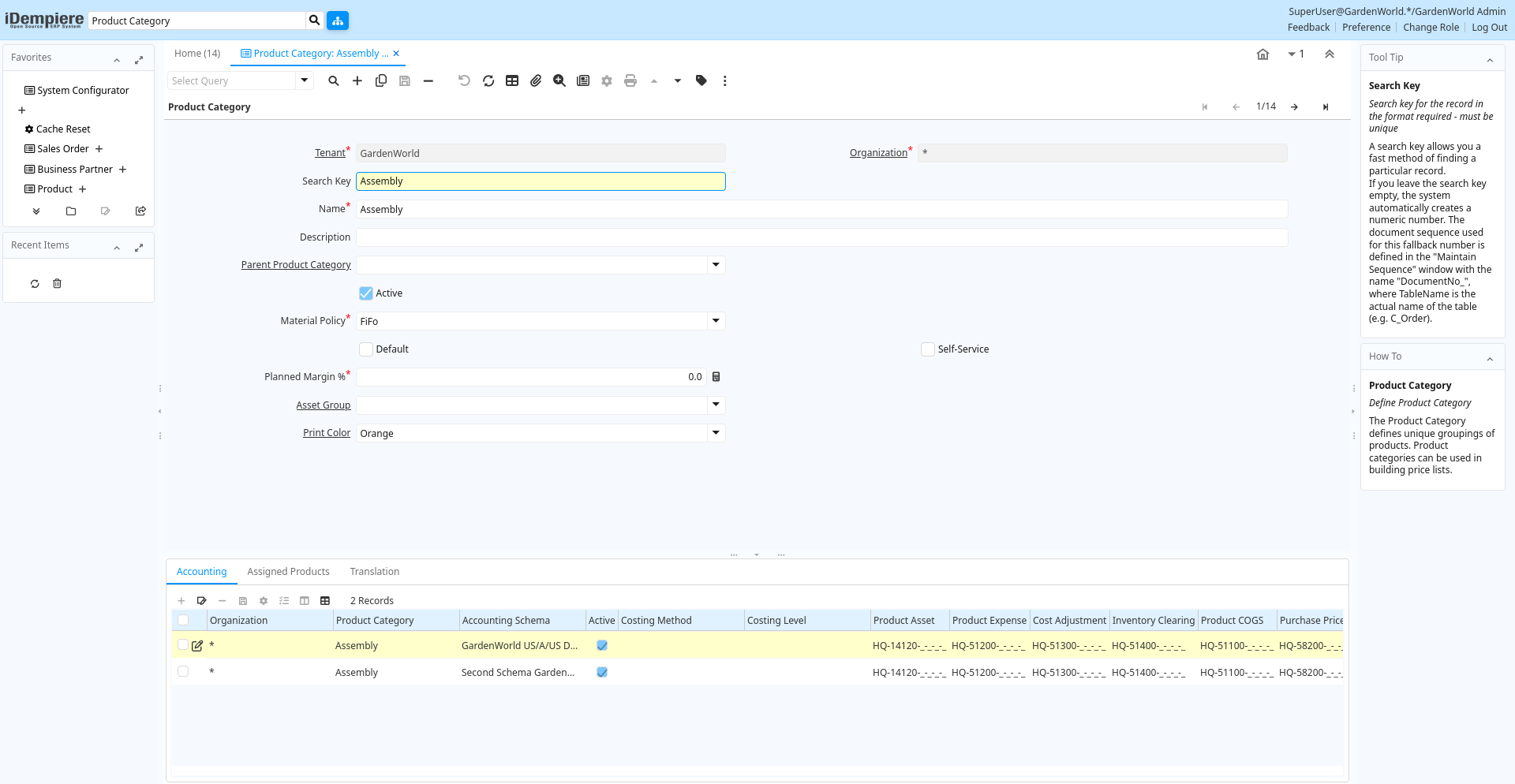
Tab: Product Category
[Created: 09/08/1999 - Updated: 02/01/2000 ]
Description: Define Product Category
Help: The Product Category defines unique groupings of products. Product categories can be used in building price lists.
Tab Level: 0
Table 10: Product Category - Fields
Table: Report Parameters
| Name | Description | Help | Technical Info |
|---|---|---|---|
| Tenant | Tenant for this installation. | A Tenant is a company or a legal entity. You cannot share data between Tenants. | m_product_category.AD_Client_ID numeric(10) Table Direct |
| Organization | Organizational entity within tenant | An organization is a unit of your tenant or legal entity - examples are store, department. You can share data between organizations. | m_product_category.AD_Org_ID numeric(10) Table Direct |
| Search Key | Search key for the record in the format required - must be unique | A search key allows you a fast method of finding a particular record.If you leave the search key empty, the system automatically creates a numeric number. The document sequence used for this fallback number is defined in the "Maintain Sequence" window with the name "DocumentNo_", where TableName is the actual name of the table (e.g. C_Order). | m_product_category.Value character varying(40) String |
| Name | Alphanumeric identifier of the entity | The name of an entity (record) is used as an default search option in addition to the search key. The name is up to 60 characters in length. | m_product_category.Name character varying(60) String |
| Description | Optional short description of the record | A description is limited to 255 characters. | m_product_category.Description character varying(255) String |
| Parent Product Category | m_product_category.M_Product_Category_Parent_ID numeric(10) Table | ||
| Active | The record is active in the system | There are two methods of making records unavailable in the system: One is to delete the record, the other is to de-activate the record. A de-activated record is not available for selection, but available for reports.There are two reasons for de-activating and not deleting records:(1) The system requires the record for audit purposes.(2) The record is referenced by other records. E.g., you cannot delete a Business Partner, if there are invoices for this partner record existing. You de-activate the Business Partner and prevent that this record is used for future entries. | m_product_category.IsActive character(1) Yes-No |
| Material Policy | Material Movement Policy | The Material Movement Policy determines how the stock is flowing (FiFo or LiFo) if a specific Product Instance was not selected. The policy can not contradict the costing method (e.g. FiFo movement policy and LiFo costing method). | m_product_category.MMPolicy character(1) List |
| Default | Default value | The Default Checkbox indicates if this record will be used as a default value. | m_product_category.IsDefault character(1) Yes-No |
| Self-Service | This is a Self-Service entry or this entry can be changed via Self-Service | Self-Service allows users to enter data or update their data. The flag indicates, that this record was entered or created via Self-Service or that the user can change it via the Self-Service functionality. | m_product_category.IsSelfService character(1) Yes-No |
| Planned Margin % | Project's planned margin as a percentage | The Planned Margin Percentage indicates the anticipated margin percentage for this project or project line | m_product_category.PlannedMargin numeric Number |
| Asset Group | Group of Assets | The group of assets determines default accounts. If an asset group is selected in the product category, assets are created when delivering the asset. | m_product_category.A_Asset_Group_ID numeric(10) Table Direct |
| Print Color | Color used for printing and display | Colors used for printing and display | m_product_category.AD_PrintColor_ID numeric(10) Table Direct |
Tab: Accounting
[Created: 18/12/2000 - Updated: 05/03/2013 ]
Description: Accounting Parameters
Help: The Accounting Tab defines default accounting parameters. Any product that uses a product category can inherit its default accounting parameters. If the Costing method is not defined, the default costing method of the accounting schema is used.
Tab Level: 1
Table 20: Accounting - Fields
Table: Report Parameters
| Name | Description | Help | Technical Info |
|---|---|---|---|
| Tenant | Tenant for this installation. | A Tenant is a company or a legal entity. You cannot share data between Tenants. | m_product_category_acct.AD_Client_ID numeric(10) Table Direct |
| Organization | Organizational entity within tenant | An organization is a unit of your tenant or legal entity - examples are store, department. You can share data between organizations. | m_product_category_acct.AD_Org_ID numeric(10) Table Direct |
| Product Category | Category of a Product | Identifies the category which this product belongs to. Product categories are used for pricing and selection. | m_product_category_acct.M_Product_Category_ID numeric(10) Table Direct |
| Accounting Schema | Rules for accounting | An Accounting Schema defines the rules used in accounting such as costing method, currency and calendar | m_product_category_acct.C_AcctSchema_ID numeric(10) Table Direct |
| Active | The record is active in the system | There are two methods of making records unavailable in the system: One is to delete the record, the other is to de-activate the record. A de-activated record is not available for selection, but available for reports.There are two reasons for de-activating and not deleting records:(1) The system requires the record for audit purposes.(2) The record is referenced by other records. E.g., you cannot delete a Business Partner, if there are invoices for this partner record existing. You de-activate the Business Partner and prevent that this record is used for future entries. | m_product_category_acct.IsActive character(1) Yes-No |
| Costing Method | Indicates how Costs will be calculated | The Costing Method indicates how costs will be calculated (Standard, Average, Lifo, FiFo). The default costing method is defined on accounting schema level and can be optionally overwritten in the product category. The costing method cannot conflict with the Material Movement Policy (defined on Product Category). | m_product_category_acct.CostingMethod character(1) List |
| Costing Level | The lowest level to accumulate Costing Information | If you want to maintain different costs per organization (warehouse) or per Batch/Lot, you need to make sure that you define the costs for each of the organizations or batch/lot. The Costing Level is defined per Accounting Schema and can be overwritten by Product Category and Accounting Schema. | m_product_category_acct.CostingLevel character(1) List |
| Product Asset | Account for Product Asset (Inventory) | The Product Asset Account indicates the account used for valuing this a product in inventory. | m_product_category_acct.P_Asset_Acct numeric(10) Account |
| Product Expense | Account for Product Expense | The Product Expense Account indicates the account used to record expenses associated with this product. | m_product_category_acct.P_Expense_Acct numeric(10) Account |
| Cost Adjustment | Product Cost Adjustment Account | Account used for posting product cost adjustments (e.g. landed costs) | m_product_category_acct.P_CostAdjustment_Acct numeric(10) Account |
| Inventory Clearing | Product Inventory Clearing Account | Account used for posting matched product (item) expenses (e.g. AP Invoice, Invoice Match). You would use a different account then Product Expense, if you want to differentiate service related costs from item related costs. The balance on the clearing account should be zero and accounts for the timing difference between invoice receipt and matching. | m_product_category_acct.P_InventoryClearing_Acct numeric(10) Account |
| Product COGS | Account for Cost of Goods Sold | The Product COGS Account indicates the account used when recording costs associated with this product. | m_product_category_acct.P_COGS_Acct numeric(10) Account |
| Product Revenue | Account for Product Revenue (Sales Account) | The Product Revenue Account indicates the account used for recording sales revenue for this product. | m_product_category_acct.P_Revenue_Acct numeric(10) Account |
| Purchase Price Variance | Difference between Standard Cost and Purchase Price (PPV) | The Purchase Price Variance is used in Standard Costing. It reflects the difference between the Standard Cost and the Purchase Order Price. | m_product_category_acct.P_PurchasePriceVariance_Acct numeric(10) Account |
| Invoice Price Variance | Difference between Costs and Invoice Price (IPV) | The Invoice Price Variance is used reflects the difference between the current Costs and the Invoice Price. | m_product_category_acct.P_InvoicePriceVariance_Acct numeric(10) Account |
| Trade Discount Received | Trade Discount Receivable Account | The Trade Discount Receivables Account indicates the account for received trade discounts in vendor invoices | m_product_category_acct.P_TradeDiscountRec_Acct numeric(10) Account |
| Trade Discount Granted | Trade Discount Granted Account | The Trade Discount Granted Account indicates the account for granted trade discount in sales invoices | m_product_category_acct.P_TradeDiscountGrant_Acct numeric(10) Account |
| Rate Variance | The Rate Variance account is the account used Manufacturing Order | The Rate Variance is used in Standard Costing. It reflects the difference between the Standard Cost Rates and The Cost Rates of Manufacturing Order.If you change the Standard Rates then this variance is generate. | m_product_category_acct.P_RateVariance_Acct numeric(10) Account |
| Average Cost Variance | Average Cost Variance | The Average Cost Variance is used in weighted average costing to reflect differences when posting costs for negative inventory. | m_product_category_acct.P_AverageCostVariance_Acct numeric(10) Account |
| Landed Cost Clearing | Product Landed Cost Clearing Account | Account used for posting of estimated and actual landed cost amount. The balance on the clearing account should be zero and accounts for the timing difference between material receipt and landed cost invoice. | m_product_category_acct.P_LandedCostClearing_Acct numeric(10) Account |
| Copy Accounts | Copy and overwrite Accounts to Products of this category | If you copy and overwrite the current default values, you may have to repeat previous updates (e.g. set the revenue account, ...). If no Accounting Schema is selected all Accounting Schemas will be updated / inserted for products of this category. | m_product_category_acct.Processing character(1) Button |
Tab: Assigned Products
[Created: 01/01/2002 - Updated: 02/01/2000 ]
Description: Products assigned to Product Category
Help:
Tab Level: 1
Table 30: Assigned Products - Fields
Table: Report Parameters
| Name | Description | Help | Technical Info |
|---|---|---|---|
| Tenant | Tenant for this installation. | A Tenant is a company or a legal entity. You cannot share data between Tenants. | m_product.AD_Client_ID numeric(10) Table Direct |
| Organization | Organizational entity within tenant | An organization is a unit of your tenant or legal entity - examples are store, department. You can share data between organizations. | m_product.AD_Org_ID numeric(10) Table Direct |
| Product Category | Category of a Product | Identifies the category which this product belongs to. Product categories are used for pricing and selection. | m_product.M_Product_Category_ID numeric(10) Table Direct |
| Search Key | Search key for the record in the format required - must be unique | A search key allows you a fast method of finding a particular record.If you leave the search key empty, the system automatically creates a numeric number. The document sequence used for this fallback number is defined in the "Maintain Sequence" window with the name "DocumentNo_", where TableName is the actual name of the table (e.g. C_Order). | m_product.Value character varying(510) String |
| Name | Alphanumeric identifier of the entity | The name of an entity (record) is used as an default search option in addition to the search key. The name is up to 60 characters in length. | m_product.Name character varying(255) String |
| Active | The record is active in the system | There are two methods of making records unavailable in the system: One is to delete the record, the other is to de-activate the record. A de-activated record is not available for selection, but available for reports.There are two reasons for de-activating and not deleting records:(1) The system requires the record for audit purposes.(2) The record is referenced by other records. E.g., you cannot delete a Business Partner, if there are invoices for this partner record existing. You de-activate the Business Partner and prevent that this record is used for future entries. | m_product.IsActive character(1) Yes-No |
| Summary Level | This is a summary entity | A summary entity represents a branch in a tree rather than an end-node. Summary entities are used for reporting and do not have own values. | m_product.IsSummary character(1) Yes-No |
| Discontinued | This product is no longer available | The Discontinued check box indicates a product that has been discontinued. | m_product.Discontinued character(1) Yes-No |
| Product Type | Type of product | The type of product also determines accounting consequences. | m_product.ProductType character(1) List |
| Expense Type | Expense report type | m_product.S_ExpenseType_ID numeric(10) Table Direct | |
| Resource | Resource | m_product.S_Resource_ID numeric(10) Table Direct | |
| Featured in Web Store | If selected, the product is displayed in the initial or any empty search | In the display of products in the Web Store, the product is displayed in the initial view or if no search criteria are entered. To be displayed, the product must be in the price list used. | m_product.IsWebStoreFeatured character(1) Yes-No |
Tab: Translation
[Created: 21/03/2014 - Updated: 27/10/2024 ]
Description:
Help:
Tab Level: 1
Table 40: Translation - Fields
Table: Report Parameters
| Name | Description | Help | Technical Info |
|---|---|---|---|
| Tenant | Tenant for this installation. | A Tenant is a company or a legal entity. You cannot share data between Tenants. | m_product_category_trl.AD_Client_ID numeric(10) Table Direct |
| Organization | Organizational entity within tenant | An organization is a unit of your tenant or legal entity - examples are store, department. You can share data between organizations. | m_product_category_trl.AD_Org_ID numeric(10) Table Direct |
| Product Category | Category of a Product | Identifies the category which this product belongs to. Product categories are used for pricing and selection. | m_product_category_trl.M_Product_Category_ID numeric(10) Search |
| Language | Language for this entity | The Language identifies the language to use for display and formatting | m_product_category_trl.AD_Language character varying(6) Table |
| Active | The record is active in the system | There are two methods of making records unavailable in the system: One is to delete the record, the other is to de-activate the record. A de-activated record is not available for selection, but available for reports.There are two reasons for de-activating and not deleting records:(1) The system requires the record for audit purposes.(2) The record is referenced by other records. E.g., you cannot delete a Business Partner, if there are invoices for this partner record existing. You de-activate the Business Partner and prevent that this record is used for future entries. | m_product_category_trl.IsActive character(1) Yes-No |
| Translated | This column is translated | The Translated checkbox indicates if this column is translated. | m_product_category_trl.IsTranslated character(1) Yes-No |
| Name | Alphanumeric identifier of the entity | The name of an entity (record) is used as an default search option in addition to the search key. The name is up to 60 characters in length. | m_product_category_trl.Name character varying(60) String |
| Description | Optional short description of the record | A description is limited to 255 characters. | m_product_category_trl.Description character varying(255) String |