Window: Dunning
[Created: 04/12/1999 - Updated: 02/01/2000 ]
Description: Maintain Dunning Levels
Help: The Dunning Window defines the parameters that will be used when generating Dunning Letters. Each customer can be associated with a Dunning Code.
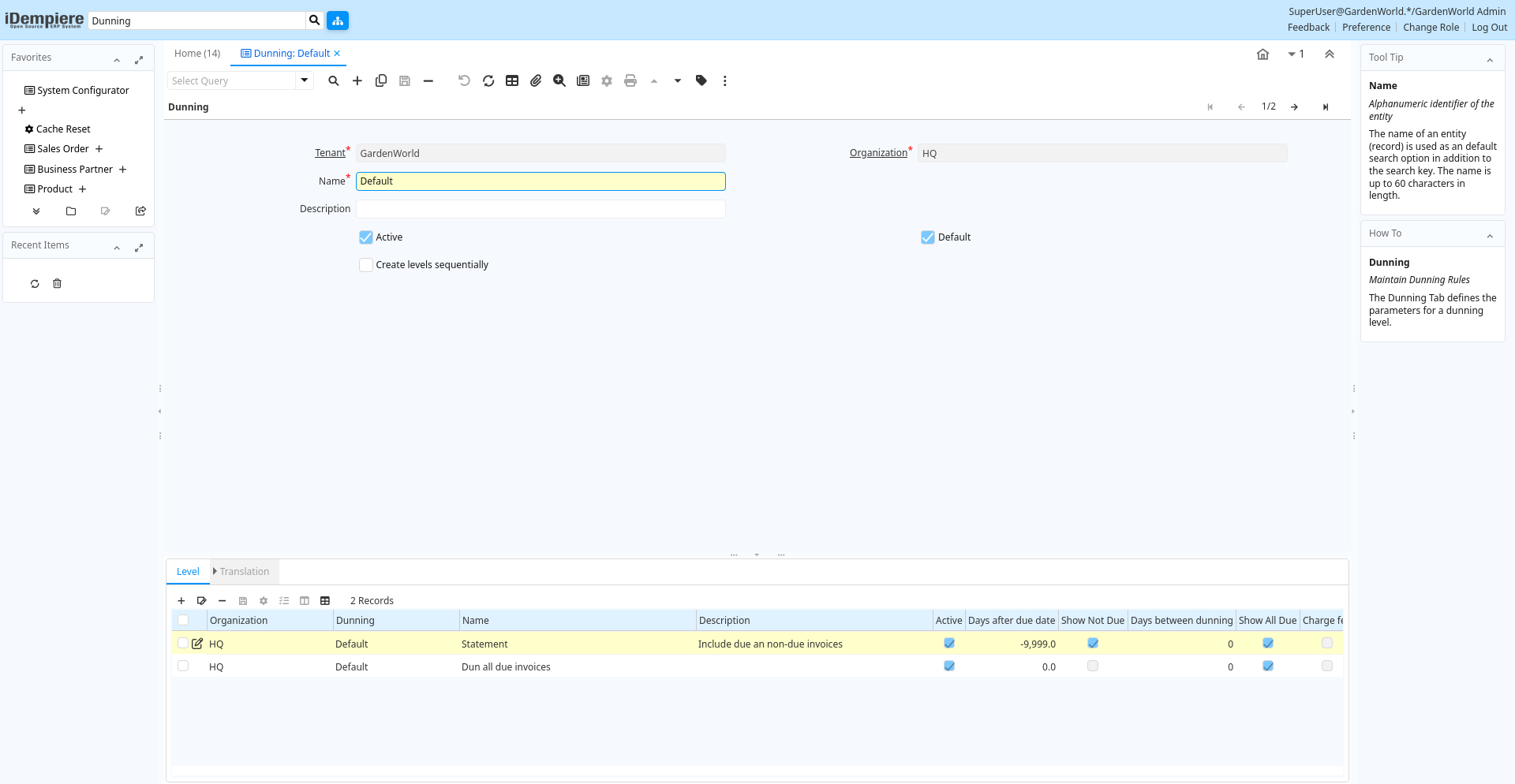
Tab: Dunning
[Created: 04/12/1999 - Updated: 02/01/2000 ]
Description: Maintain Dunning Rules
Help: The Dunning Tab defines the parameters for a dunning level.
Tab Level: 0
Table 10: Dunning - Fields
Table: Report Parameters
| Name | Description | Help | Technical Info |
|---|---|---|---|
| Tenant | Tenant for this installation. | A Tenant is a company or a legal entity. You cannot share data between Tenants. | c_dunning.AD_Client_ID numeric(10) Table Direct |
| Organization | Organizational entity within tenant | An organization is a unit of your tenant or legal entity - examples are store, department. You can share data between organizations. | c_dunning.AD_Org_ID numeric(10) Table Direct |
| Name | Alphanumeric identifier of the entity | The name of an entity (record) is used as an default search option in addition to the search key. The name is up to 60 characters in length. | c_dunning.Name character varying(60) String |
| Description | Optional short description of the record | A description is limited to 255 characters. | c_dunning.Description character varying(255) String |
| Active | The record is active in the system | There are two methods of making records unavailable in the system: One is to delete the record, the other is to de-activate the record. A de-activated record is not available for selection, but available for reports.There are two reasons for de-activating and not deleting records:(1) The system requires the record for audit purposes.(2) The record is referenced by other records. E.g., you cannot delete a Business Partner, if there are invoices for this partner record existing. You de-activate the Business Partner and prevent that this record is used for future entries. | c_dunning.IsActive character(1) Yes-No |
| Default | Default value | The Default Checkbox indicates if this record will be used as a default value. | c_dunning.IsDefault character(1) Yes-No |
| Create levels sequentially | Create Dunning Letter by level sequentially | If selected, the dunning letters are created in the sequence of the dunning levels. Otherwise, the dunning level is based on the days (over)due. | c_dunning.CreateLevelsSequentially character(1) Yes-No |
Tab: Level
[Created: 25/01/2000 - Updated: 02/01/2000 ]
Description: Maintain Dunning Level
Help: The Dunning Level Tab defines the timing and frequency of the dunning notices.
Tab Level: 1
Table 20: Level - Fields
Table: Report Parameters
| Name | Description | Help | Technical Info |
|---|---|---|---|
| Tenant | Tenant for this installation. | A Tenant is a company or a legal entity. You cannot share data between Tenants. | c_dunninglevel.AD_Client_ID numeric(10) Table Direct |
| Organization | Organizational entity within tenant | An organization is a unit of your tenant or legal entity - examples are store, department. You can share data between organizations. | c_dunninglevel.AD_Org_ID numeric(10) Table Direct |
| Dunning | Dunning Rules for overdue invoices | The Dunning indicates the rules and method of dunning for past due payments. | c_dunninglevel.C_Dunning_ID numeric(10) Table Direct |
| Name | Alphanumeric identifier of the entity | The name of an entity (record) is used as an default search option in addition to the search key. The name is up to 60 characters in length. | c_dunninglevel.Name character varying(60) String |
| Description | Optional short description of the record | A description is limited to 255 characters. | c_dunninglevel.Description character varying(255) String |
| Active | The record is active in the system | There are two methods of making records unavailable in the system: One is to delete the record, the other is to de-activate the record. A de-activated record is not available for selection, but available for reports.There are two reasons for de-activating and not deleting records:(1) The system requires the record for audit purposes.(2) The record is referenced by other records. E.g., you cannot delete a Business Partner, if there are invoices for this partner record existing. You de-activate the Business Partner and prevent that this record is used for future entries. | c_dunninglevel.IsActive character(1) Yes-No |
| Days after due date | Days after due date to dun (if negative days until due) | The Days After Due Date indicates the number of days after the payment due date to initiate dunning. If the number is negative, it includes not the not due invoices. | c_dunninglevel.DaysAfterDue numeric(10) Number |
| Show Not Due | Show/print all invoices which are not due (yet). | The dunning letter with this level includes all not due invoices. | c_dunninglevel.IsShowNotDue character(1) Yes-No |
| Days between dunning | Days between sending dunning notices | The Days Between Dunning indicates the number of days between sending dunning notices. | c_dunninglevel.DaysBetweenDunning numeric(10) Integer |
| Show All Due | Show/print all due invoices | The dunning letter with this level includes all due invoices. | c_dunninglevel.IsShowAllDue character(1) Yes-No |
| Charge fee | Indicates if fees will be charged for overdue invoices | The Charge Fee checkbox indicates if the dunning letter will include fees for overdue invoices | c_dunninglevel.ChargeFee character(1) Yes-No |
| Fee Amount | Fee amount in invoice currency | The Fee Amount indicates the charge amount on a dunning letter for overdue invoices. This field will only display if the charge fee checkbox has been selected. | c_dunninglevel.FeeAmt numeric Amount |
| Print Text | The label text to be printed on a document or correspondence. | The Label to be printed indicates the name that will be printed on a document or correspondence. The max length is 2000 characters. | c_dunninglevel.PrintName character varying(60) String |
| Note | Optional additional user defined information | The Note field allows for optional entry of user defined information regarding this record | c_dunninglevel.Note character varying(2000) Text |
| Dunning Print Format | Print Format for printing Dunning Letters | You need to define a Print Format to print the document. | c_dunninglevel.Dunning_PrintFormat_ID numeric(10) Table |
| Credit Stop | Set the business partner to credit stop | If a dunning letter of this level is created, the business partner is set to Credit Stop (needs to be manually changed). | c_dunninglevel.IsSetCreditStop character(1) Yes-No |
| Set Payment Term | Set the payment term of the Business Partner | If a dunning letter of this level is created, the payment term of this business partner is overwritten. | c_dunninglevel.IsSetPaymentTerm character(1) Yes-No |
| Payment Term | The terms of Payment (timing, discount) | Payment Terms identify the method and timing of payment. | c_dunninglevel.C_PaymentTerm_ID numeric(10) Table Direct |
| Collection Status | Invoice Collection Status | Status of the invoice collection process | c_dunninglevel.InvoiceCollectionType character(1) List |
| Is Statement | Dunning Level is a definition of a statement | c_dunninglevel.IsStatement character(1) Yes-No |
Tab: Translation
[Created: 25/01/2000 - Updated: 27/10/2024 ]
Description: Dunning Level Translation
Help:
Tab Level: 2
Table 30: Translation - Fields
Table: Report Parameters
| Name | Description | Help | Technical Info |
|---|---|---|---|
| Tenant | Tenant for this installation. | A Tenant is a company or a legal entity. You cannot share data between Tenants. | c_dunninglevel_trl.AD_Client_ID numeric(10) Table Direct |
| Organization | Organizational entity within tenant | An organization is a unit of your tenant or legal entity - examples are store, department. You can share data between organizations. | c_dunninglevel_trl.AD_Org_ID numeric(10) Table Direct |
| Dunning Level | c_dunninglevel_trl.C_DunningLevel_ID numeric(10) Table Direct | ||
| Language | Language for this entity | The Language identifies the language to use for display and formatting | c_dunninglevel_trl.AD_Language character varying(6) Table |
| Active | The record is active in the system | There are two methods of making records unavailable in the system: One is to delete the record, the other is to de-activate the record. A de-activated record is not available for selection, but available for reports.There are two reasons for de-activating and not deleting records:(1) The system requires the record for audit purposes.(2) The record is referenced by other records. E.g., you cannot delete a Business Partner, if there are invoices for this partner record existing. You de-activate the Business Partner and prevent that this record is used for future entries. | c_dunninglevel_trl.IsActive character(1) Yes-No |
| Print Text | The label text to be printed on a document or correspondence. | The Label to be printed indicates the name that will be printed on a document or correspondence. The max length is 2000 characters. | c_dunninglevel_trl.PrintName character varying(60) String |
| Note | Optional additional user defined information | The Note field allows for optional entry of user defined information regarding this record | c_dunninglevel_trl.Note character varying(2000) Text |
| Translated | This column is translated | The Translated checkbox indicates if this column is translated. | c_dunninglevel_trl.IsTranslated character(1) Yes-No |